Jude Collins

Tuesday, 30 July 2013

GAA games and Ulster teams


I’ve just checked and I note that, of the eight teams in the All-Ireland Football quarter-finals,  four are from Ulster. That’s quite an achievement and not one that's received a lot of comment from the media. Maybe that’s because three of the teams - Cavan, Monaghan and Donegal - are from Ulster but not from Ulster-as-some-know-it.  For example, I used to work in the University of Ulster. I remember when the name of the new university was announced, one staff member spent some time impressing on us all how lucky we were to have the word ‘Ulster’ in our title.  She didn’t explain why we should feel lucky but she made it clear that we were very lucky. Had anyone asked if the Ulster in question included Donegal, Monaghan and Cavan, I suspect she would have considered that a question in very bad taste. 

More relevantly, over the years I’ve been in and out of the BBC doing bits and pieces of one kind or another for near to thirty years. In all that time, I’ve never heard any of the staff express surprise or unease about the title ‘Radio Ulster’.  Were they asked, I expect senior staff would reply that the Ulster they had in mind was the Ulster of Northern Ireland - i.e., the six counties. Any suggestion that the name Radio Ulster overstated the station reach would be dismissed as nit-picking. 

Anyway, to get to the point. Let’s suppose (although I hate to even think of it) that Tyrone are knocked out of the competition on Saturday and the other three Ulster teams march on  (an unlikely outcome but possible).  Will Radio Ulster and BBC Television Northern Ireland continue to cover games with the same enthusiasm?  Let’s say it’s a possible but unlikely scenario. Because, you see, the N Ireland team - Tyrone - will be gone, so what would be the point?

To even ask that question is to misunderstand the average Gaelic football fan. He or she will of course wish to see his/her team continue in the competition; but if they’re gone, that doesn’t mean their interest has ended. Is there a fan in the country who won’t want to see Dublin playing Cork? Or, say, Kerry playing Donegal?  But be sure of this: they may watch such games on television, but it won’t be on BBC Northern Ireland television. 


Who said politics had no place in sport?

Monday, 29 July 2013

Reports from a phony war


Did you know there was a war on? I don’t mean somewhere else  in the world (there are always several wars raging somewhere) but right here in our own little wobbly-lined corner?  It’s  a culture war, apparently, with the winners being those who produce evidence of a stronger, more appealing culture.  Now that the ceasefires have been called and the Good Friday Agreement firmly in place, we’re struggling to overcome each other with cultural weapons.

A better term for that would be arty-party propaganda.  Create cultural artefacts, celebrate those in existence, in order to get one up on the other lot. Alas, that's an enterprise doomed to failure. The more you concentrate on producing/appreciating something so that it’ll be useful somewhere else - in this case the political arena -  the more you’re going to produce/express appreciation in a half-baked, skin-deep way that’s totally unconvincing. 

I saw an example of that no later than last Saturday. The marching bands strutting their stuff to show they still wanted to pass the Ardoyne shops were supported by people, often women, carrying banners and signs. One placard in particular caught my eye: ‘Walking is our culture’. Sometimes you don’t know whether to laugh or cry. A form of exercise, a means of getting from A to B - but a culture?

There is no doubt that Irish culture here is flourishing, through song, music, dance and language. The best-known song on the unionist side is probably The Famine Song, the best known music that produced by the Lambeg drum,  the best-known dance  Scottish dancing and the best known language the interesting dialect that’s not a language, Ulster-Scots. 

As a nationalist I’m happy to see Irish culture alive and thriving but I don’t see it as a weapon to use against my neighbours who have a different political allegiance. What I would hope is that my neighbours would realise that what’s seen as the other lot’s culture is in fact their culture as well. 

In an interview with Frances Tomelty years ago, I asked her about competition and jealousy in the acting world. She acknowledge that it existed but saw it as a blot on the profession. In her view, good acting was something that all actors could learn from and share in; the road of begrudgery and spite led nowhere.

She could have been talking about culture in this tormented corner. Culture is there to be shared by all.  One group of people who realise that and are availing of it  are the many people learning Irish at the East Belfast Mission, led by inspirational people like Linda Ervine.  Such people have the wisdom to see that culture is most valuable when it’s celebrated in an open, inclusive way, not used as a weapon with which to bash over the head those we dislike/hate. 


Sunday, 28 July 2013

Sectarian bigots and repentance

Once more, Sunday Sequence on BBC Raidio Uladh/Radio Ulster kick-starts my thinking today.  Rev Gary Mason of the East Belfast Mission was on and drew a parallel between alcoholism and sectarianism: “I am a recovering sectarian bigot” he told listeners.  Good line. Somebody tweeted in that this was a marvellous example of leadership.

Sorry. Can't agree. If sincere, it’s a good example of openness and humility, but I find myself getting impatient with this  “We are all to blame” approach to our problems. I don’t dispute that there’s sectarianism in all of us, to a greater or lesser degree. But saying that and/or conceding that you yourself have been guilty of it doesn’t take us anywhere. 

What I’d call leadership would be if a prominent person in the public eye were to say “I am a recovering sectarian bigot” and then list examples of the sectarianism/bigotry  they’ve been guilty of and how they recovered from it. Now that would be impressive. That would be leadership. 

Nelson McCausland devoted a blog to me some time ago, denouncing me as a sectarian bigot. As I watched Nelson in his Orange sash at the front of the protestors with Nigel Dodds yesterday, I thought how marvellous it would be if , instead of seeing the bigotry in others, our leaders were  to acknowledge their own bigotry, citing chapter and verse. And how they'd managed to leave it behind. I think that would be true leadership. 

It was Gary Mason also this morning (I think) who commended Martin McGuinness for referring to ‘Derry/Londonderry’.  He figured it helped develop confidence within the unionist community. Personally I think it’s an awkward name but if people feel reassured by its use, fine. A bit like Raidio Uladh/Radio Ulster, I suppose.  


But can I conclude with an appeal? Regardless of your sectarianism and/or repentance of it, please oh please don’t ever, even if threatened with violence, refer to “the island of Ireland”. Except maybe if you’re a geography teacher. We don’t say “the human being Gregory Campbell”. Then please oh please don’t state the bleedin’ obvious when you talk about Ireland.

Saturday, 27 July 2013

The Irish Seanad: another way to screw the poor


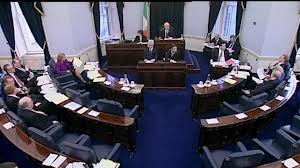
Would it be a good idea for the south to get rid of its Seanad? That’s a debate that’s running with some energy on the other side of the border these days. There’s talk of how much it would save were the Seanad abolished, much talk  about the Seanad holding  politicians to account, and the claim that it’s the Dail that needs reforming, not abolition of the Seanad.

Simon Coveney,  a Fine Gael minister was on RTE the other day talking about the need to get rid of the Seanad. Mary O’Rourke of Fianna Fail was on the same programme making the case for its retention. 

The main argument against an upper House  (as in England) is that the people in it are not democratically elected. For example, I’m a graduate of the National University of Ireland and so am entitled to a vote that’d send three senators to the Seanad. If I’d been a graduate of Trinity College I’d have been allowed to vote for their three Senators. In other words, people who’ve been to university are seen as being somehow more suitable for voting candidates into the Seanad than the great unwashed non-graduate population. Once you start drawing those kinds of distinction, you’re waving goodbye to any real respect for equality. 

The main argument in favour of retaining the Seanad is that it provides a check on the elected representatives in the Dail, that there’s a degree of expertise in the Seanad that can curb the wildness and possible ignorance of the Dail.  The answer to which, of course, is that those elected to the Dail should be informed and un-wild - they shouldn’t need another body to remind them to act responsibly. 

And did I mention that each Senator gets paid at last count €65,000? You’d need to be giving some very wise advice to make that kind of money well-earned. 


But actually, my own distaste for the Seanad is not that it’s undemocratically elected, not that they get paid too much, but that it’s duplication. Having elected TDs  to the Dail, the Irish people should tell them to get on with it, not pay grateful attention to an unrepresentative bunch of overpaid  layabouts shovelling fistfuls of money into their pockets, while the rest of the state’s population is struggling to keep body and soul together. 

Friday, 26 July 2013

Sauce all round or no sauce at all


When I first heard that a commemorative parade/march was to be held in Castlederg for two IRA volunteers who were killed while transporting a bomb in 1975,  I thought it was a bad idea. Marching in general I find faintly absurd: if you want to honour someone or something, is it not possible to do so from a stationary position? Why the need to do it on the move?

Jeffrey Donaldson it seems agrees with me (not that he knows/cares what I think - it’s purely coincidence): he says Castlederg is still living with the legacy of the Troubles. “It was the location of a very high number of IRA atrocities over the years, and that legacy lives on”.

It seems difficult to dissent from that statement; like many other places in the north, the wounds of loss are still far from healed in Castlederg and environs.  Then I read what Sinn Féin MLA Declan McAleer had to say. He claimed the parade would come from a nationalist area of the town and go through the shared space of the Diamond. Then he added “In Castlederg there are almost 20 parades from the broad unionist community every year, many of which go through the town  centre, and none of which have been objected to by nationalists”.

That for me clinched the argument and should be at the centre of any dispute over parades. As I say, I’d be in favour of banning all marches of any kind: do it on the spot or not at all.  But if parades/marches must happen, then there needs to be balance. And for Jeffrey Donaldson or anyone else to object to a republican commemorative march while supporting some 20 unionist marches in the same place is  lacking in logic, let alone parity or balance. 

Of course you’ll have noted Jeffrey’s term ‘atrocities’. And the BBC habitually refers to any IRA killings as ‘murder’,  while rarely describing killings by the forces of the state as ‘murder’.  But what do the 3,000 + marches here every year commemorate? A battle in which some 1500 men were killed. Do those killings become legitimate because they occurred a long time ago? Or is it that the 1500 deserved to die? Or was God not on their side? Does time dim the picture of carnage?

Orange banners habitually honour prominent warlike figures - those who led others into battle, who encouraged the slaughter of one set of human beings by another. In my book, the rightness or wrongness of an act doesn’t change because a long time has passed. So far from being in favour of banning the IRA commemoration in Castlederg, it seems to me the local republicans would be justified in holding another 19 similar marches. 

It’s that old key question that so many unionists (and maybe some republicans) like to duck: How would we feel if they did to us what we’re doing to them? In this case, if the Orange goose gets its plentiful supply of sauce, it's unreasonable that a spoonful of the same sauce should be denied to the republican gander.


Thursday, 25 July 2013

A day of sadness and solidarity


There’s power, soft power - and then there’s community. 

I was over in West Tyrone at a funeral of a cousin of mine - Tom Dolan -  yesterday. It was an impressive experience. There was sorrow at the heart of it, in the loss of a man who was my year in St Columb’s College in Derry; but there was support and strength and community spirit that counterbalanced the loss. As the dead man’s brother remarked, when he went to St Columb’s College in 1951, there wasn’t a single football in Aghyaran; now it’s a positive fortress of Gaelic games. The massive GAA hall sits right beside the church and it was there the mourners went after the funeral Mass for something to eat. The spread was impressive - a huge array of main dishes to choose from, dessert arriving the moment you’d finished your main course, cups of tea served and re-served to each table. I’ve been in hotels that weren’t nearly as well stocked or organised. 

The church itself was packed with mourners; and there were stewards with hi-viz bibs to direct the heavy traffic to the parking places. And all of this without any sign of the official world of police or other civic authorities. The sense that the community had come together to support the family and each other in the time of loss was almost palpable. Over the meal there was little talk of politics: instead there were anecdotes about the deceased, enquiries about other family members, memories of school days (I re-met two septuagenarians I last saw when they were seventeen), and football games played half a century ago. 

People sometimes talk about the greening of the West. This felt more like visiting an independent republic, confident in itself, welcoming to outsiders, steeped in Gaelic culture and games. I remarked to one priest there that the GAA seemed to have replaced the Catholic Church as the hub, the powerhouse of the community. He  agreed without hesitation, and if he had a sense of regret he didn’t show it.


It’s a long way to Tipperary. It’s a much, much longer way from Westminster -or Stormont - to Aghyaran. As British as Finchley? You’re joking. 

Wednesday, 24 July 2013

Nuclear power and nuclear powers


Japan is a unique country. It’s the only one in the world to have suffered from the dropping of atomic bombs on two of its cities, with terrible consequences. It’s also one of the few countries in the world to have had meltdown in one of its nuclear plants. Right now they’re doing what they can to prevent radioactive water from seeping into the sea.  Steam has been seen rising from the plant in recent days, which shouldn’t be the case since they thought they’d cooled it down long ago. The fact is, as one commentator remarked on radio this morning, they’re making it up as the go along, for the good reason that they’ve never faced anything like this. But they do know that it’ll take f40 or 50 years to dismantle the plant and it’ll cost around $50 billion at today’s prices.

Meanwhile in Britain, the government is telling its people that it’s absolutely essential for them to have a nuclear strike force. Although a nuclear submarine isn’t a problem, it’s notable that they keep theirs as far away from London as they can - up in Scotland in fact. In fact, Scottish moves towards independence is giving the English a headache: where are they going to put their nice totally-necessary nuclear submarines if an independent Scotland were to kick them out?

We hear more and more experts tell us that nuclear power is the only option to save the planet, since it provides ‘clean’ energy compared to oil or coal. On the other hand, when something goes wrong as it has in Japan, nobody really knows what to do. And they know that the effects of relying on nuclear energy has long-term consequences. Relying on nuclear weapons, of course, means that you believe it’s totally legitimate to reduce to dust millions of people in the name of liberty.

I’ve a suggestion. Any party that enters an election with a programme that includes either nuclear energy or nuclear weapons should be boycotted, regardless of what other goodies they may promise. And I remain to be convinced that somebody, somehow, isn’t making big money at the expense of a poisoned planet.