Jude Collins

Tuesday, 10 July 2012

Did Kesh beat the world Orange Banner record?


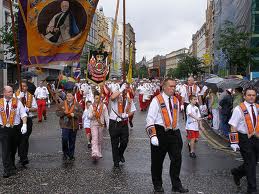
With the Twelfth bearing down on us like a neutered pit-bull high on ecstasy, it's good to know the Orange Order has retained its sense of humour. Even though it was expected to disrupt traffic, hundreds of Orangemen were to assemble in a field somewhere near Kesh, Co Fermanagh, in an attempt to beat the world record for assemblage of Orange banners in one spot. This attempt was being organised by Pettigo Loyal Orange Lodge and  more than 300 banners were expected to gather in the field.  Problem was,  people who would normally park their cars in fields (doesn't everyone?) would be forced, due to the recent wet weather, to park at the roadside, which risked creating traffic bottle-necks. 

I've been on edge to find out the results of this world record attempt, not just because if cars risk getting stuck in soggy fields, so too do the Orangemen gathered with their banners, but because Pettigo is the town near which my mother grew up. Ah me, the heart-warming stories she used tell me at bed-time of Catholics and Protestants standing shoulder to shoulder, hand-in-hand, cheering the bands on the Twelfth! Mind, this was decades before Sinn Féin entered  the picture and manipulated residents' groups so that, instead of continuing to stand hands clasped with their unionist neighbours, they started to claim that Lambeg drums and anti-Catholic speeches and half-pissed Orangemen were something they found in some vague way offensive.

But look, I'm getting misty-eyed. Those were back in the days when everyone got along, when people shopped,  traded, went to each other's religious services with never a thought of who was Orange and who was Green, when Catholics looked forward as much to the fun of the Twelfth as did their Protestant neighbours.  Only then the IRA started the Troubles and ruined things for all of us.

Anyway, to get back to Kesh, if you know that the banner-bearers were successful in their world record tilt and didn't get that sinking feeling their cars might have experienced, let me know. And if you know they failed in their attempt, let me know as well.  If there's one thing you can be sure of every Twelfth, there'll be something that'll give you a good belly-laugh.

Saturday, 7 July 2012

Arise, Sir John


It's not always that I agree with the Dean of Northern Journalism, Eamonn Mallie. But I'm with him on this one - John Hume accepting a papal knighthood would be - although Eamonn would never stoop to such language - a crock of shit. For a start there's the timing. No, not because as Eamonn puts it: "Why accept an honour from an institution which has visited so much hurt on the young and innocent?" You might as well say "Why give credence to an institution which has visited so much hurt on the young and innocent by going to Mass with your children on a Sunday?" No, the timing has to do with Hume himself. When a papal knighthood offer might have had some merit would have been when Hume started his talks with Gerry Adams, and the Indo and all the southern media were going bananas about the shame of it all.  A papal offer at that point would have shown that the papacy stood by those who were genuine peace-makers like Hume (and Adams) rather than Sir Tony O'Reilly and his assorted lackeys. But did it come at that time, when most needed? Not a chance. The church waited until Hume, as Mallie points out, was top-heavy with honorary degrees and awards. It's like waiting to see which way the wind is blowing, and only when there's a hurricane of approval behind the chosen one do you make up your mind.

Plus, of course, the idea of knighthood has been inextricably linked with the British Honours List, so if Hume were to transform himself to Sir John, he'd have to keep explaining to nationalists it was the pope that gave it to him, not that other one with the thing on her head.

Finally, the rich and/or powerful conferring distinctions on those they deem worthy is itself a  crock of smelly stuff. Who are they to tell us who's worthy  of distinction? Shouldn't we be telling them? Oh but I forgot - neither the papacy nor the monarchy are too much into democracy. Heavy on bowing and scraping, though. 
.

Friday, 6 July 2012

We're all British here, aren't we?


Did  I read somewhere that Kate Hoey was in a snit because somebody kept referring to ‘Britain’ when they should have been referring to ‘the UK’, the reason being that  to say ‘Britain’ would be to leave Northern Ireland out, even though as we all know, we're all British here. Although though a good number are Irish. As well. I hope you’re keeping up with me.

If Kate said nothing of the sort, a thousand apologies Kate, these days when I don’t take the tablets you’ve no idea the things I start imagining. But this particular idea-thing seemed to have the ring of possibility, since the people living in the island next door do have a tendency to leave out NI when talking about Britain. I’m sure they don’t mean to hurt sensitive feelings on our side of the water, any more than, when there’s a Northern Ireland topic under debate in the House of Commons, those who speak sounds as though they’re addressing each other from the bottom of a well, such is the echo produced by practically nobody being present in the chamber. Those British MPs don’t want to wound those of us British separated from them by the Irish Sea, they just, um, well, it’s boring, innit, those Irish, that’s to say British over in Ulster.

Did I say Ulster? I shouldn’t have said that, should I? Unionist politicians, or a section of them, have a copyright on that word, which they use when they really mean Northern Ireland. So if Kate DID say that about Britain/UK, maybe now she knows how those twisted nationalists in the north of Ireland feel when unionist politicians blithely ignore the existence of three of Ulster’s nine counties.

But hey, we’re talking about Britain here, aren’t we? All of us in NI are British citizens, with all the rights and privileges and joys that go with that, right? Which is why I got such a shock when I was over in London today (no, not Londonderry – I’m talking about the capital of my country), I tried to buy coffee and some buns in Knightsbridge.
When I flashed a Northern Bank £20 they said ah no, we don’t take those, sir, we only take sterling. Eh? I said. But sure this is sterling. Ah no, I’m afraid we can’t take it. What you say may be true, sir, but it’s not the kind of sterling we  recognise or take in this part of the world, no offence, of course, chuckle, chuckle, yes indeed, of course we take debit card, that’ll be lovely.  

Maybe I should send Kate to have a talk with them. I mean, what’s the point in us being loyal subjects and putting up arches and beating drums until our fists bleed, if they won’t even take our money?

Thursday, 5 July 2012

Did you hear the one about the Giant's Causeway Visitor Centre?


OK. This Boson particle walks into a pub and the barman says “What’s the matter?”  Boom-boom.

I expect you’re falling around on your chaise longue at that one. If you’re not there might be a suggestion you don’t understand what the Boson particle thing is all about .  If you don’t, welcome to the club – I don’t either. But I gather it has something to do with the reason why everything exists when, quite reasonably, things might not exist.

Which brings us to the Giant’s Causeway. The great Dr Johnston, you’ll remember, when asked what he thought of the Giant’s Causeway after he’d been there, said “The Giant’s Causeway is worth seeing, but not worth going to see”. However it’s not its scenic impact that’s up for discussion this morning. It’s that in the new Visitors’ Centre, they’ve an audio presentation that explains the origin of the Causeway in traditional scientific terms and also in creationist terms.

Pleased with that, are you? Or disgusted that Christian fairytale stuff is given equal time with science?

It depends on what you mean by creationism, and how the Visitors’ Centre presents creationism. If it says that the Causeway was created by God via his Flood, and we know this because the Bible tells us Noah had to build an ark, etc, then it’s a bit daft and people in need of a good laugh will head for north Antrim. If on the other hand the creationism version accepts evolution and simply puts the case that the Causeway, like everything else,  is ultimately the product of intelligent design of some sort – what most people call God  - then they’re entitled to have that point of view heard. It’s what Christians believe.

Let’s face it: most people, myself included, have a very shaky grip on science. When we’re told that the universe came into being by way of the Big Bang, we nod wisely, even though it sounds like something from a three-year-old’s picture book. No explanation is given as to why the Big Bang should have happened rather than not happened, or why it was such  a smart Big Bang that it created everything we now have. In terms of religion, people can be literal and gullible – it’s in the Bible so it must have happened. Likewise in terms of science, a lot of people can be literal and gullible – it’s what the scientists tell us so it must be true . Even though science keeps changing and sometimes contradicting what went before.

The world,  the universe is an amazingly varied and beautiful and terrifying place. Maybe the God-made-the-world-in-six-days crowd should be bit less dogmatic and intolerant.  And maybe the rest of us should accept that when we give credence to the scientific community, it’s not because we understand their claims – as with religious belief, we make an act of faith.


Wednesday, 4 July 2012

Six things Drew would like Dublin to know. Or maybe not.


Yesterday, Drew Nelson, Grand Secretary of the Grand Orange Lodge of Ireland was down in Dublin addressing the Oireachtas. The problem the Orange Order has, apparently, is that it’s misunderstood, so Drew would like people in the south to know more about the institution. With this in mind, here are some facts about the Orange Order that might help Dublin politicians decide whether Drew’s proposed Orange march through Dublin would be a good idea.

1. The founding documents of the Orange Order say, 'An Orangeman should not merely be somebody who has hostility towards the distinctive doctrines, the superstitions, the priestcraft and spiritual despotism of the Church of Rome.'

2. The 'Constitution, Laws and Ordinances of the Loyal Orange Institution of Ireland' (1967) states: "No person who at any time has been a Roman Catholic ... shall be admitted into the institution, except after permission given by a vote of 75pc of the members present founded on testimonials of good character.

3.  Today, as always, each member of the Orange Order is pledged to: “strenuously oppose the fatal errors and doctrines of the Church of Rome, and scrupulously avoid countenancing (by his presence or otherwise) any act of ceremony of Popish worship; he should by all lawful means, resist the ascendancy of that Church, its encroachments, and the extension of its powers”.

4.. Early in 1992, loyalist gunmen killed five Catholics who were in a betting shop on the Ormeau Road in Belfast. Months later, a parade along the road sparked fury when some of the Orangemen present made "five-nil" hand gestures as they passed the murder scene.The then Northern Ireland Secretary Sir Patrick Mayhew accused those responsible for the taunts of behaving like 'cannibals' ".

5.  On July 12, 1996, Robert Saulters  - who was later elected Grand Master of the Orange Order on December 11 - told the Orange Order, that the British Prime Minister, Tony Blair, " has already sold his birthright by marrying a Romanist. He would sell his soul to the devil himself. He is not loyal to his religion. He is a turncoat " 

6. A few years ago, George Galloway, then an MP, described the Orange Order as  "sectarian, anti-Catholic, Protestant-supremacist". A defamation suit was pursued against him by the Orange Order in Britain. Judge Lord Kingarth who threw out the case, ruled it was "a fair comment on that organisation".


Tuesday, 3 July 2012

Is the GFA enough, or is unionism entitled to say 'We want more'?


I was on a radio discussion with nice Alex Kane last Sunday, and although I didn’t think it at the time, I was told by several people we clashed fairly resoundingly.

The essential point was whether Sinn Féin were doing the right thing by unionists.  It seemed to me that they were but Alex begged to differ. If they were doing the right thing, he said, they would apologise to unionists for the actions of republicans over the period of the Troubles. If they were doing the right thing, they would state publicly that only when/if ever a majority of unionists in the north agreed to constitutional change would it come about. 

My response was Holy God, Alex. If republicans and republicans alone apologise, this boxes them into a corner where they appear to be saying 'We were in the wrong all along. We were just a group of thousands of criminals who went on a killing spree for several decades'.  If apologies were to be handed in, they should be handed in simultaneously by ALL parties to the conflict. No hierarchies please, Alex.

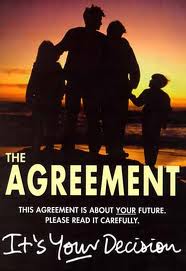
The other point, about the need to announce that only when a majority of unionists had agreed to constitutional change should it happen: that’s not what was signed up to in the Good Friday Agreement. It explicitly talks about a majority in Northern Ireland, not a majority of unionists. So why sign up to something and then start demanding stricter terms? Besides which, I know there are republicans who would be willing to wait until a majority of unionists were agreeable to constitutional change, but that’s another matter.

And please, people, we’re talking here about the road towards constitutional change, not how far there may or may not be to travel.

I really do like Alex, but he occasionally adopts some very odd positions for a rational, intelligent man.

Sunday, 1 July 2012

Conversation with a good man


Father Gerry Reynolds is expecting me and not expecting me at the same time. He’s suggested  a 12.00 pm interview for today only he doesn’t know I’ve said yes, please, because his email system has gone wonky.  But  even though preparation for the Clonard Novena are to be seen and heard all around, he’s soft-spoken and unhurried. We settle in our armchairs in Parlour 3  at  Clonard Monastery and I ask him about his childhood. 

He grew up on the edge of Limerick city, where his father was a small farmer who sold milk to the city dairy. He remembers his father well – getting a box on the ear  from him for having done something wrong, his father codding him that he could send a message to someone far away by speaking into a little hole in the wall.  It sounds like a warm, normal father-son relationship. Then when he was six years old, everything changed. 

“My dad was going into Limerick city on a horse and cart . A lorry was driving out and the man driving it might have been a bit under the influence. But a bar projecting from the side of the lorry hit my dad. His leg was broken in three places and he went into hospital. This was the age before penicillin, and with blood poisoning, they weren’t able to handle it. He died two months later, in July 1941. I remember being brought into the mortuary to see my dad laid out. I remember touching his body – his head – and it so cold.”

Many things led to him becoming a priest. He was an altar boy, he had two uncles who were priests, the community in which he grew up was supportive of his vocation.

“And there were moments in my life that drew me to God – little moments of revelation, really. I remember when I was a very small fellow, being out in the meadow one day, looking for flowers for the May altar, and having an extraordinary experience of finding a flower that just blew my mind, it was so beautiful. It was an experience, sort of, of a divine presence. That sense of God’s presence in his creation. You get something of it in Patrick Kavanagh: ‘That beautiful, beautiful, beautiful God/ Was breathing his love in a cut-away bog’.”

That sort of moment, as well as the occasional encouraging word from a local priest, from a farmer as they walked home after a day’s work in the field: “He said ‘Good lad, that’d be a good thing to do’. Though I remember too in a hurling match, shortly before I left home to join the Redemptorists, saying I was going there to another fellow – we were hurling together -  and he told me ‘Don’t be an eejit!’  But I didn’t listen to him and I was jolly glad I didn’t!”  He leans back in his chair and laughs at the memory.

I ask him about being posted to Belfast – how did the image in his head match with the reality?

“I came in the summer of 1983. What I found was, Belfast was very, very different, from reading about it in the papers or hearing about it on the television.  You were right up against the reality of Belfast. Just ordinary people caught up in this terribly sad and tragic struggle. The suffering of it, the pain of the people, and the courage of the people as well – you’d be encountering that. And the awful violence that I never could understand. I never would just condemn people  - they all followed their own lights; but from a human point of view, to take human life is a terrible thing. My commitment to peace-making is profoundly a religious commitment – a commitment to the living God who doesn’t want us to be at war with one another.”

But did he ever feel that people from outside his community might see him as being on the side of republicanism?

“I never worried about what way people saw me. I was myself. I mean I was and am an Irish nationalist. I believe that Ireland is for the Irish people, it’s wrong to have it occupied and all of that. But my reaction to that was to work gradually towards transforming people’s attitudes, endeavouring to connect with people on the other side.  I remember Brother Hugh Murray – he was an old Brother in the monastery at the time -  and Hugh used to talk with me. We’d be on the top corridor of the monastery, looking out at the Shankill, and he would say to me ‘You know, we’re all the same people – the very same. We’ve all been exploited, never really got a fair reward for our work, and the tragedy of it is, we’re at each other’s throats’.  I came two years after the hunger strikes, in 1983, and from the beginning I came as a learner, trying to understand, but with a deep conviction. People used to say to me ‘They’ll always be fighting here’. I never believed that, because God doesn’t will us to be fighting. And what God wills for us is always possible, if we commit ourselves to it and work for it.”

He’s not dismayed by the state of disarray and crisis in the Catholic Church at present. He’s just back from the Eucharistic Congress in Dublin. 

“It’s the first Eucharistic Congress that was ecumenical. It began with a day where the Church of Ireland Archbishop of Dublin presided over the celebration of our communion in baptism.  I thought that was a glorious day, a tremendous boost for us all. Even committed Catholics can be battle-weary,  a bit down, lacking morale. But I don’t think anyone who attended the Eucharistic Congress will lack morale or confidence or hope. The Congress has been an immense blessing – that’s my read of it.”

I comment on the hammering sounds outside as men prepare for the Clonard Novena. Why is it that the Novena is so popular with people?

“I think it touches into the heart of the Gospel message – that God is good, God is loving, God is gracious, God is merciful. And the great sign of the mercy of God is the mother of Jesus who is there drawing us to her Son. People sense something of that. They’re drawn by the simplicity of it. There are lots of people come to the Novena who don’t go to Mass on Sundays at all. Even though you maybe meet them one-to-one at the Novena and encourage them, that now you’ve kind of come back again, make Sunday the central day in your week, make the Eucharist central to your life.”

There is, he concedes, an awful lot of work to be done in that respect. Does that fact not sadden him?

He laughs again. “What’s the good in being sad? But yes, it saddens me to some extent. Our liturgies could be much better. We’re drawn in the liturgy into the mystery of God. And as people realize that, they’ll be drawn to the Mass, drawn to worship.”

Has his life been a lonely one?  He’s a celibate man, a member of the Redemptorist order, with no wife or family.  Has it been lonely?

“No, not at all. Obviously you miss the intimate partnership of a woman whom you love, but that’s the sacrifice you lay on the altar, that deep need to be loved and to love.  To share in begetting a child and children  - I chose not to opt for that way of life, so it’s a decision that I freely made and I’m happy in.  I have friends in my life, including women friends, who are greatly supportive to me. So I’m happy. It’s not a lonely life. If it were a lonely life you couldn’t live it.  You have to be ravished, again and again, by the beauty and goodness and loveliness of God. It’s like the poem by John Donne – ‘Batter my heart, three-person'd God’”.

And blimey,  he recites the entire Donne sonnet, word-perfect. In the best sense, this man knows more than his prayers. 

I remind him of the saying that when you come to the end of your days, what you’ll regret is not what you’ve done but what you didn’t do. Looking back, is there anything he hasn’t done that he wishes he had?

He laughs. “At the end of every day I have regrets about what I didn’t do!  I’ve tended to let my life unfold, I haven’t been a great planner of my life. I didn’t set goals - the Redemptorists have offered me the goals that I have. I suppose there was a time when I wished that I were assigned to Brazil. Some of my class-mates were going to Brazil  and there was some talk of it at the time. Then I was sent to Limerick as rector down there and I experienced, I suppose, failure as a rector, and that was tough. But it’s just another part of the journey. I’ve never carried any resentments or anything from that. Had I not failed in Limerick, I probably wouldn’t be in Belfast today. And I’m grateful to God that the providence of my life led me to Belfast, led me to Clonard, led me to work for the reconciliation of the churches. And whatever I contribute, I do my little best”.

As he sees me to the door, I have a sudden image of a football crowd – you know how it is when a player is coming off, the fans do a sort of hands-raised bow, in a we-are-not-worthy gesture? That’s what I’m feeling as I shake hands and  leave. You kind of know in your bones when you’ve been in the presence of true goodness, don’t you?