Jude Collins

Wednesday, 18 January 2012

Advice to government: bring your cheque-book


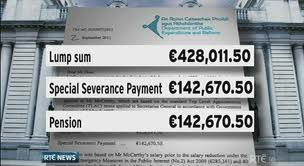
A bit of a barney in the Dail yesterday, by all accounts. It seems that three years ago, government advisers were handed over one million euro of tax-payers’ money; at present, that has shrunk to an annual € 576,000.  Hooray, hooray, hooray. Only then a barney was raised by Gerry Adams and then Micheal Martin because, apparently, Enda Kenny had been caught breaching the cap that’s been put on pay to government advisers, by intervening so the adviser in question got a higher salary. Micheal Martin said that  eight out of fifteen salaries had broken the government’s own guidelines. Meanwhile the Minister for Education, Ruairi Quinn, explained why it was “simply not possible” to  intervene regarding cuts in education, including cutting staff levels. Not good news for the 1,000 guidance counselors in the south who may well lose their jobs. Quite a few in languages and science may also go.

Clearly these special advisers are really classy people. Guidance counselors and language or science teachers spend around five years getting equipped for their jobs, so presumably the special advisers must have trained for even longer. Funny, though, that I’ve never actually heard of a School of Government Advisorship in any university. Have you?

Meanwhile here in the north we had our own brouhaha a while back over a special adviser having once been an IRA member. As, of course, were the Deputy First Minister, the Minister for Regional Development, not to mention the criminal record of both the present First Minister and his predecessor. All great fun to talk about, but of course what special advisers are judged by  - should be judged by – is the quality of their advice. 

For example, Steven King, late of this parish, advised David Trimble and the Ulster Unionist Party. So too did the former Paul Bew, now elevated to the dizzy heights of being Lord Bew, presumably in recognition of the quality of his services. The fact that their advice coincided with a period when the Ulster Unionist Party did a Costa Concordia, never to sail again, was purely coincidental. Wasn’t it?

Ah, advisers. You know why they get paid so much. Because they’re worth it.


Tuesday, 17 January 2012

The Costa Concordia - no, Virginia, it's NOT like the Titanic


Quite a sight it made: the luxury liner Costa Concordia on its side like some giant mechanical whale, beached with no hope of escape. Who's to blame? The owners for not seeing to it that everything was shipshape? The captain for sailing recklessly close to shore to give a bravura salute to those watching from the land? The people who constructed the ship so that there was a fatal weakness that has now resulted in, what, nearly thirty people dead?

One thing we can be pretty sure of: in a hundred years' time, no city or port will bust a gut trying to remind the world that the Costa Concordia was built by them. No city or port, in their desperate bid to win world attention, will construct a ship-shaped building to remind people that this was where the Costa Concordia was put together. No city or port will shell out on that building £20 million which, if what we hear is right, may never be recovered. No city or port will spend millions refurbishing the boat that ferried passengers to this ghastly vessel.

How different, then, from the way our own dear city of Belfast has responded to the Titanic  gravy-train: "Let us on, we've as much right to a seat as  Cork or anywhere else. I mean, look at us - we're terrific, we built this ship! No one else can say that!"

If you want proof positive that Belfast is an Irish rather than a British city, try following the logic of that one. Listen, guys: it sailed, it sank, get over it. And stop shovelling millions into the memory of this sea-going coffin for the super-rich.

Sunday, 15 January 2012

BBC's Sunday Sequence - better and better

Sunday Sequence's William Crawley 

If BBC Radio Ulster/Raidio Uladh's Sunday Sequence  gets any better, it'll be a must-listen and half  the church-going population will arrive late. This morning it had David Vance and Finola Meredith on, talking about those recent images of American soldiers urinating on dead Taliban. To say they differed would be to put it mildly. Finola thought that urinating on dead bodies was disgusting, inhuman and totally defenceless conduct, which struck me as a fair description. David thought that...well I found it hard to tell what David thought. He talked about how bad the Taliban were and how he had a website called 'A Tangled Web' that didn't have racist stuff by him on it, and how putting those images on Youtube or wherever was inhuman, or was it terrible, or maybe deserving of punishment, but the urinating itself...No I'll stop,  I'm afraid I'm an unreliable witness. I kept having this red mist at the notion that someone was  whataboutering around this  ghastly act.  Finola Meredith, from what I've seen of her, is not a woman who loses her temper easily, but she came near to it this morning with Vance.

And then, as if that wasn't enough, the programme produced Anthony McIntyre and Danny Morrison talking about the Boston tapes - those recorded interviews with a selection of participants, loyalist and republican, where they talk about who did what in the Troubles.  The people used were given an assurance that what they said would not be made public until after their death; unfortunately, this was an assurance no-one could give, as Boston College apparently knew and Anthony McIntyre and his colleague Ed Moloney should have known. Now it's looking as though the tapes may pass to the PSNI ; what was to remain confidential will no longer be so.

Morrison, who believes he was slandered on the tapes,  argued that Moloney and McIntyre shouldn't have encouraged people to make claims about what others did as well as what they themselves did, and that they should have been warned the information could be seized and passed to the authorities.  McIntyre said they'd been more or less misled by Boston College and that in hindsight yes, they should have sought legal advice before embarking on the project.

Just two comments - for the moment. One,  if I'd been doing such interviews,  the first thing I'd have checked would have been the legal possibility of anyone else having access to this stuff?  It's almost inconceivable that Moloney and McIntyre didn't think of knocking on a very sharp lawyer's door before they started recording.

The second thing is,  Moloney and McIntyre really should stop referring to this project as "research".  A basic ingredient of  research is that the sample you use reflects the larger population; in this case, only those with an anti-Sinn Féin perspective on the Troubles got used. Sorry, chaps. Skewed sample, skewed research.  There must be a better word for the Boston project.

Friday, 13 January 2012

The royal visit - because She's worth it?


I’ve been accused of having a thing for QE2, so to even mention the woman who makes men walk backwards out of rooms is to invite criticism. But given the latest Irish tourism figures, she has to be factored in. 

Do you remember those glorious days last May? When the people of the south of Ireland  queued up for the honour of being near the British monarch? There were hard-headed people who objected to that visit because, among other things, they thought that money spent on banquets and massive security  - €7 million, was it? - would have been better spent on hospitals or the lengthening dole queues. The short-sightedness of these people was quickly corrected by those in authority, when it was explained that her visit would give publicity to the tourist industry that money simply could not buy. The millions spent would be returned in increased tourist numbers, pressed down and running over.

Well, the tourism figures for last year have just been released and yes, there has indeed been a change in tourism figures. But according to The Irish Times  yesterday, “visitors from Britain – Ireland’s biggest source of overseas visitors – dropped by 2%”. During  the first three months, before the south was graced by the royal presence, the figures were stronger;  the figures after she visited, in the latter part of the year, showed a falling-off. Fewer, not more people came to Ireland.  Where there were positive figures,  the tourism people are attributing the increase to the government’s reduction of VAT rather than the aroma left by the royal presence. What’s more, a lot of criticism has been directed at  the tourism people for focusing too much on existing markets like Britain and not going after tourists from growing economies like China and Brazil.

 Since I have a thing for Her Majesty, I’ve done what I can to see the numbers in a positive light but they stubbornly resist. It very much looks like those days in May not only cost the southern Irish taxpayer millions s/he could ill afford, but the pundits who went on about reaping a royal harvest either lied or got it spectacularly wrong.

But let’s be positive – let’s try to learn a lesson. A suggestion: this year, the south’s government might want to offer the royal coffers say, €3 million, on the promise no royal person will set foot on Irish soil in the coming year and the hard-pressed tourism industry will be given a chance to get off its knees. Because last time out, Her Majesty appears to have delivered tourism, not a boost, but a regal boot in the face. 

Thursday, 12 January 2012

Should Britain chair our examination of the past?


There are areas I feel uncomfortable talking about and one is, how we should respond to the victims of our Troubles. My unease springs from the fact that I’ve been lucky enough not to have lost a loved one, and when you haven’t suffered that kind of pain you don’t really know what’s involved. That said, there are a few general points worth making on the topic, even for someone as ignorant as I am of the suffering involved.

1.     The Belfast Telegraph  today reports that Sinn Féin have agreed to take part in talks about dealing with ‘the legacy of the Troubles’. Since the British Secretary of State is chairing the talks, I doubt very much if Sinn Féin will be happy to proceed very far with this arrangement. I hope they don’t. By taking the chair, Paterson is implicitly offering the old lie that our Troubles are about a pair of crazy tribes with Britain the civilized referee, detached, above all this hatred and killing.

2.     Some of the combatants involved in the Troubles will be willing to tell the truth about their part in particular killings, others won’t.  This applies on all sides,  but nowhere with more completeness than on the British side.  You may point to David Cameron’s apology for Bloody Sunday as contradiction; but keep in mind that the Saville Inquiry into Bloody Sunday cost the huge sums it did because the British government fought with fist and boot to avoid releasing any documents which might show their forces in a bad light. We still don’t know who were the people killed the fourteen shot dead on Bloody Sunday. And that’s just one example. Britain has cast itself in the role of peace-keeper not combatant in our Troubles, so how can a party with clean hands be expected to have anything other than chairmanship to contribute?


3.     The loved ones of different victims have different needs. Some simply wish to have the truth recounted; others demand justice. Both are understandable stances, but is it sensible to allow those who have suffered to be the ones who decide if the perpetrators will be punished? Being so emotionally involved, they are the least likely to produce a dispassionate decision on the matter. And justice requires dispassion.

4.     We pride ourselves on how our peace process has been a model for other conflicts in other areas of the world. Are there any models from elsewhere and the past that we might follow in coping with victim pain? And don’t say “South Africa”: there are a lot of people in South Africa profoundly unhappy with their truth and reconciliation format.


5.     It’s a hard thing to say but it may be that time will provide the answer. Not that time will produce a blueprint to be followed but that time will pass, those who have suffered will grow old and die, and eventually the pain now felt will diminish very, very slowly. That’s what happened with the Irish Civil War, a brief but truly brutal conflict. It’s a poor solution but maybe the only one we can really rely on. 

Wednesday, 11 January 2012

Enough generalities - the Village area can deal sectarianism a deadly blow


It’s a long way from the Village area of Belfast to Stormont.  You can work at an official level towards a shared – and improved – future, but you can’t legislate for the conversion of sectarian morons like those who attacked young James Turley the other day and left him for dead. Why did they do this? Because he was ‘a taig’. If you’d been looking for an example of full-frontal sectarianism, you’ve just found it. These knuckle-dragges weren’t looking to settle some old inter-community score – they just wanted to attack/leave for dead a taig.  

I’m just off the Nolan Show on BBC Radio Ulster /Raidio Uladh, where this topic was discussed. Dawn Purvis, former leader of the PUP, was keen to stress that sectarianism runs right through all classes of our society in the north, and she’s right. Where she’s wrong is in putting the emphasis at this moment on desegregated housing, desegregated schools, desegregated communities.  The focus now should be firmly on this  primeval attack which is bad for the reputation of the decent people of the Village area, bad for the film industry here and bad for the reputation of the north in general. 

So what to do? Two simple actions would help considerably.  First, it would take no more than five minutes for Peter Robinson and Martin McGuinness, as First and Deputy First Minister to appear before the cameras together, as they did when PC Ronan Kerr was killed, and label these thugs and their actions in emphatic terms. Second, this attack happened in broad daylight – there are bound to be people in the Village area who know who they were. If they truly detest what happened, they should identify the  troglodyte attackers to the PSNI, they should be arrested and they should learn that actions have consequences and that vile actions have very, very uncomfortable consequences.  

  We all learn best by example. If the top of our society – Stormont – and the ground-level of our society -  the Village area – were to act as one in this case,   make it clear that they totally disown such people and their stupid, vicious actions, you’d be surprised how that co-ordinated action would send ripples of approval and attitude-change throughout our society.  If they don’t, then let’s hear no more preaching from the top or pretence that sectarianism isn’t welcome and nurtured at community level. 

Tuesday, 10 January 2012

Whither Sinn Féin?


Where is Sinn Féin going? "Nowhere, in the south anyway" was the answer  Eoghan Harris gave,  a few short  years back. Then  at the last election Sinn Féin almost trebled its numbers in the Dail. Even this was a minor disappointment for some of the more ambitious party members.

Writing in The Irish Times today, Paul Cullen reckons the party have a five-year plan and are working "with a view to further gains in the next general election and the pivotal role in forming the next government that would accompany such success".

Since that statement could be made about nearly any political party, Cullen has hardly produced a major insight. If you listen to the Shinners' opponents, and to some extent to Cullen, you would conclude that their goal is power and that they have ditched and will ditch any principle  to acquire that power. But power to do what?

Ask the average punter on the street what Sinn Féin stands for and you'll be told "A united Ireland". How would gaining power or sharing power in the south advance that ambition? Well, some people believe that the sight of, say, a Sinn Féin Minister of Education in the south meeting with a Sinn Féin Minister of Education in the north would be a powerful symbol of the strides the party has made towards Irish reunification. Those opposed  would say that like the cross-border bodies, such a meeting would be a  meaningless gesture, the kind that Fianna Fail and other southern governments have been making towards Irish unity over the last eighty or ninety years.

It depends on how you see Irish unity coming. If you believe  it will come, if at all, in one intense, probably violent short period, as did the establishment of the Irish Free State, you'll dismiss Sinn Féin in government in the south and north as sell-out window-dressing. If you believe that Irish unity will come gradually, as more and more powers shift into the hands of Irish people,  then you'll see Sinn Féin's five-year plan and beyond as  important and so far, in the teeth of fierce opposition, successful. The increasing integration of the party into mainstream politics north and south can be seen as the betrayal of everything Irish men and women fought and died for over the past forty years, or the practical, patient movement towards realisation of their dream.

One thing is sure: the major barrier to Irish reunification now lies south of the border, not north of it.