Jude Collins

Monday, 31 January 2011

Terry Wogan: wink-and-chuckle man


I watched the second of the Terry Wogan two-parter ‘ Terry Wogan’s Ireland’ on BBC TV last night and found myself feeling sorry, sorry, sorry I’m not English.  Had I been, I’d have loved the programme. There were lots of aerial shots showing gorgeous green fields and slate-blue water, lots of cheerfully-painted shops and comfortable cars (Terry in a chauffeur-driven Merc) and lots of compliant local celebs  ( Brian D’Arcy,  Gerry Anderson, David Norris).  And running through it all, the soft spine of a blancmange hour,  Terry himself...Sorry. Sir Terry himself.

Was there ever a man better able to glide over the awkward truth of things? He visits South Armagh: yes, it was known as bandit country during the Troubles but would you look at the Irish dancing! He talks with Brian D’Arcy: yes, there was terrible abuse in the Catholic Church but would you look at the Celtic beauty of Lough Erne! He tramps the walls of Derry with Gerry Anderson:  yes there was Catholic-Protestant antipathy but burble burble burble. He talks with David Norris, present front-runner to succeed Mary McAleese as President of Ireland: wasn’t the late Queen Mother wonderfully Irish with her fag and gin and love of horses, and really, it’s all tosh, there’s no difference between Irish and English people,  we’re all a mixture. He talks with Gay Byrne: no, Terry doesn’t believe in God, but if he dies and discovers there is one, he’ll say ‘I don’t believe it! Ha ha haaaa!’  Injustice, war,  national identity, eternity itself: all smoothed away with a reassuring chuckle from good old Sir  Tel. Wouldn’t it be great if all Irishmen were like that all of the time?

Sunday, 30 January 2011

Doing the time for whose crime?


I remember once when I did some freelance work for a radio station. After the main news, one of the reporters would provide a summary of the day’s business news. It was a job everyone tried to dodge, for the good reason that nobody at the station had an economics background. I remember one reporter emerging from his stint live on air, slumping at his desk and confessing “I hadn’t a clue what 90% of that meant!”

Maybe that’s why Irish journalists have been hopeless at explaining the IMF/EU bail-out for Ireland - beyond the brutal fact that it’ll take around three generations before it’s paid off. Irish politicians have been equally useless at explaining what’s involved, probably because like my radio reporter, they too understand only about 10%, although they too are clear that it’ll take three generations of sack-cloth and ashes before the state is in the black again.

Recently, though, one other point about the bail-out has been filtering into the public consciousness. It’s that ordinary people are being asked to pay for the bad investments of others. Initially Fianna Fáil politicians presented the bail-out as grim reality, the result of debt which the Irish people had incurred, and that we should all be grateful to the IMF/EU for saving the state from collapse. But now as Fianna Fáil recede like the vanishing dot on the old TV, there’s a growing conviction that the Irish people are being shackled to the financial wall, not for their own financial sins, but for the financial sins of others. It’s the Birmingham Six / Guildford Four all over again: painful to be in prison for crimes you’ve committed, insufferable to be in prison for crimes others have committed.

If that analysis is accurate, that generations of Irish people are being punished for debt which really belongs with the bond-holders and big investors, and if the election allows people to say firmly “Can’t pay, won’t pay!”, four weeks of having to look at Pat Rabbitte’s neck will not have been in vain.

Friday, 28 January 2011

Gerry Adams can't spel!


High on my list of things that send me running for a pillow to pull over my head so I can shriek without sending the cat up the living-room curtain is the kind of person who goes on about literacy levels. “Kids today – they can’t spell!  They write ungrammatical sentences! What’s education come to if people can’t write?”  They then pull out several examples of these terrible sins and waggle their eyebrows at you. Granted, time spent doing this kind of thing keeps these critics off the streets or from torturing helpless animals,  but it ignores the fact that  Shakespeare consistently made spelling mistakes, that the final chapter of James Joyce’s masterpiece Ulysses  is without a single full stop, and that book shops and libraries are stuffed with unreadable books in which the spelling and punctuation are flawless.

In the past couple of days we’ve had similar brain-numbing nonsense about Sinn Féin’s economic competence. Gerry Adams was asked in a BBC interview the other day if he knew the child benefit rate in the south or the south’s VAT rate: he didn’t. This has been seized on as evidence that Mr Adams doesn’t know what he’s talking about in terms of the south’s economy, and that Sinn Féin as a party haven’t a clue about getting the south’s finances on an even keel. Final proof of this incompetence? Adams’s failure to answer the child benefit and the VAT questions are linked to his failure in a TV debate  with Michael McDowell of the PDs during the 2007 election.

Dear God. Supposing Gerry Adams had known what the child benefit rate was, and the VAT rate, and all the other facts and figures about the south’s finances…What would that have proved? Being able to spell and punctuate isn’t much use if you’ve got nothing useful to say; being able to reel off facts and figures is of little help if you can’t produce a strategy for getting the state’s finances in order. In the famous 2007 debate, McDowell was seen as having wiped the floor with Adams; what is glossed over is the fact that McDowell was spouting the Celtic-Tiger-hooray philosophy of the time and Adams was warning against a corrupt system that rewarded financiers at the expense of ordinary people.

There’s little merit in being a champion speller or sentence writer if your book says nothing worth reading, there’s little merit in being a slick debater if you’re talking dangerous tripe, and there’s no merit in radiating facts and figures (think Garret Fitzgerald) if your idea of good economics is to sink a state into ball-breaking debt, yea even unto the third generation, so bankers can collect bonuses and the Irish people are left to pick up the tab for big-time bond gamblers. 

Please, interviewers. Stop asking Gerry Adams if he knows the price of bottled gas and ask him what Sinn Féin can offer to help the Irish people – and do the same with politicians from other parties. Enough of the would-you-look-at-that-he-can’t-spell-onomatopoeia school of criticism. 

Wednesday, 26 January 2011

Fine Gael and Labour: do their bums look big?


Hands up if you remember the arrival of the IMF people in Dublin? It seems an age ago but when they first came, a weird version of the Emperor’s new clothes began.  Everybody knew they were in town, everybody knew a  bail-out was about to happen, but Brian Lenihan and Fianna Fail stayed blank-faced and in denial: no, no, no, no, no, there were no negotiations,  there were no plans for meetings, there was no question of a bail-out,  IMF officials, what IMF officials?  Next thing,  Lenihan and Fianna Fail are knee-deep in, not so much negotiations as receiving stern instructions as to what would happen. Cue removal of Emperor’s new clothes.

The scene in today’s Dail  will be a bit like that. Nearly everyone wants the Finance Bill to go through.  What would normally take weeks and weeks will  go zinging into legislation inside four days. Don’t you love it? Legislation that will effectively crucify the non-wealthy in the south will be fast-tracked by Fianna Fail and the Greens. Fine Gael and Labour, of course, are against this happening. That’s why they’ve agreed to remove any obstacle to the Bill’s passage. You want a clear run, with no awkward questions or other legislation?  You got it. You want to make sure this Bill is passed before the general election? You got it. Are we – Fine Gael and Labour – in favour of this Bill? Of COURSE not - we’re completely opposed to it.  Can’t you see how opposed we are? The  Emperor’s new clothes all over again: Fine Gael and Labour swearing they’re clad head-to-toe in anti-Bill finery when the rest of us seem convinced they’re as naked as new-born scaldies.

You need proof? Then watch what happens if Michael Lowry and/or Jackie Healy-Rae follow through on their mutterings and refuse to support Fianna Fail and the Greens in voting through the Bill.  Fine Gael and Labour will be forced into the open, forced to vote for the Bill or at best abstain. The instant they do, the game will be up. Like it or lump it, the electorate will see their silly pretend-game collapse and they’ll stand there in all their skinny-dip glory.

Oh God. Time to lie down. I’ve just thought what Pat Rabbitte might look like...

Tuesday, 25 January 2011

Labour and the sweet smell of a Merc


It’s not always what you say so much as how memorably you say it. On RTÉ’s ‘The Frontline’ last night, Sean Sherlock of Labour, a pleasant-looking lad, was trying to explain why Labour, who are opposed to the Finance Bill, are going to be voting FOR the same Finance Bill in the Dail later this week. It’s a tough one but he did his best. He’s a Corkman and Corkmen have a way with words, even in a tight situation. Then Pat Kenny asked Sinn Féin’s Pearse Doherty for his views.

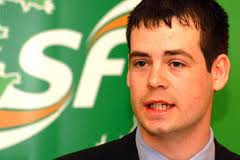
Doherty has got beefier. Only a couple of weeks ago he was a slightly gawky, long-necked lad from Donegal. Now his face is fuller, his neck thicker – he looks like he’s matured physically. And politically? Well, if his choice of words is any indication, he’s a veteran already. When poor young Sherlock had sort of collapsed back into his seat after struggling to explain that Labour were opposed to and at the same time going to help pass the Finance Bill, Doherty responded. He said that Sherlock and Labour were now acting as they were because they’d got “a whiff of ministerial leather” and couldn’t wait to occupy their new government Mercs.

Young Sherlock spotted the problem immediately and tried to damp down the blaze by telling Doherty that such a remark was out of order, was a low blow, was unacceptable. The result of that was, the viewing public did a quick mental rewind, played again the “whiff of ministerial leather” remark and cemented it into their political picture. This was  firmed up later in the programme when Pat Kenny AND a man in the audience repeated the phrase.

What’s so important about a “whiff of ministerial leather”? Because grasping political issues is hard work. Words are slippery things – that’s why political cartoons are often more successful than political columnists. So when a well-turned phrase pops up that seems to summarise something broad and complex – this time Labour’s reasons for acting as it did – then the public’s mind snaffles it up. “A whiff of ministerial leather” - it appeals not to our sense of sight or hearing, but smell. We all know that yummy pong of a new car, and better still an expensive new car, and better still an expensive new car that you get to use and don’t have to pay for. Suddenly all Labour’s high-minded explanations for not pulling the plug on the government fly out the window and are replaced by the image of Labour TDs getting all hot and moist as the smell of power spirals up their nostrils.

Not fair, maybe not even totally truthful. But unforgettable.

Monday, 24 January 2011

We're all agreed (well, nearly all...)


A number of men called at my door on Saturday afternoon. They said my house, their houses, all the houses in the neighbourhood were in danger of burning down, and the only way to avoid the danger was to write a blank cheque and give it to them.  At first I resisted but then I figured that all those people couldn’t be wrong so I passed them the cheque.  They said they’d let me know later what protection would cost me but that I’d made the right choice.

That paragraph above is all lies, of course. But it’s not far from what’s happening in Dublin at the moment. Fianna Fáil, Fine Gael, Labour, the Greens – all the parties except  Sinn Féin are falling over themselves to insist that the Finance Bill must be passed before the dissolution of the Dail and a general election. So even though there are supposed to be serious differences between potential coalition partners Fine Gael and Labour, and crucial differences between the two main parties, Fianna Fáil and Fine Gael, and the Greens are seen as different from everybody –  when it comes to signing off on legislation that’s going to hammer the most vulnerable in the south’s society, they’re united. It must happen immediately.

Do you know what the main elements of the Finance Bill are? Do you know what would be lost if there was an election and then the Finance Bill was passed? When it comes to the crunch, is there a postman’s piss of difference between the mainstream parties in the south?

And there was you, thinking things were changed now that Cowen is gone...

Saturday, 22 January 2011

Brian bows out


Having just watched Brian Cowen resign as leader of Fianna Fáil, I'm tempted to say "Nothing in life/Became him like the leaving it", but of course he's not leaving political life, he's going to be Taoiseach for the next seven weeks. Will he run for re-election in Laois/Offaly? It's hard to say. Probably he will since he has a loyal following there, but if he does, it'll be like the proverbial decapitated chicken, still walking because it doesn't realise it's dead.

Cowen says he has resigned for the good of the party. Given the level of contempt that has swirled around him in recent months, inside and outside his party, it's a credible statement. He's also credible when he says he has always done what he believed to be the right thing. But as he made his statement and fielded questions from journalists, I was struck by his overall demeanour: that of a plain, honest and intelligent person. If you think for a moment on the candidates in the running to succeed him, there is none who could have conducted him/herself with Cowen's poise and dignity. Leave aside the question of whether he's a competent economist or his policies make sense: he projects a self-belief and ability that is impressive. Hell, I'll admit it: I like the guy. Create a mental picture of him, then place beside him his near-anointed successor, Micheál Martin. Do you begin to see how literally and metaphorically lightweight Martin looks, in contrast? In fact when I think of Martin, my thoughts go to a Fianna Fáil politician who had the same mild manner, the same soft-spoken style, the same inoffensive way with him. Will Fianna Fáil rue the day they elected as their leader a man who bears such an unnerving resemblance to Bertie Ahern?